
Echoes of Scotland
with Edward Dusinberre - Violin
Saturday, February 20, 2027
7:30 – 9:30 PM
Boulder Adventist Church
Bahman Saless
Music Director
with
Edward Dusinberre - Violin
Program
Felix Mendelssohn (1809–1847)
The Hebrides Overture, Op. 26, “Fingal’s Cave” (1830; rev. 1832)
Max Bruch (1838–1920)
Scottish Fantasy, Op. 46 (1880)
I. Introduction: Grave – Adagio cantabile
II. Scherzo: Allegro
III. Andante sostenuto
IV. Finale: Allegro guerriero
Edward Dusinberre - Violin
Felix Mendelssohn (1809–1847)
Symphony No. 3 in A Minor, Op. 56, “Scottish” (1842)
I. Andante con moto
II. Vivace non troppo
III. Adagio
IV. Allegro vivacissimo – Allegro maestoso assai
About the Artists
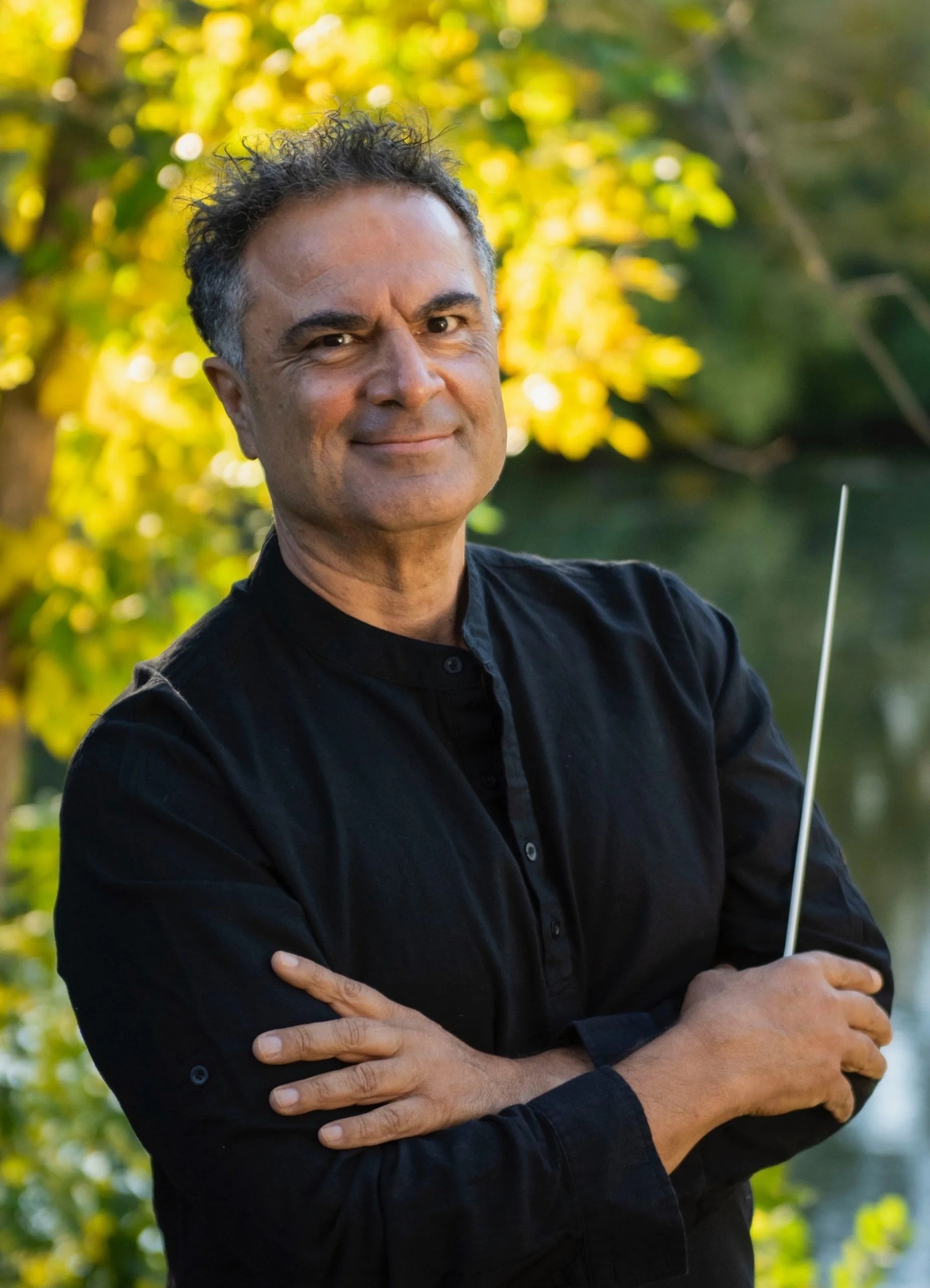
Bahman Saless
Music Director
A conductor for the 21st century, Bahman Saless has been described as “entrepreneurial, creative, and plugged in,” and “an innately talented musician and conductor, without frills or ego.” His passion is palpable, his enthusiasm contagious, and the results he draws from musicians are, as one colleague put it, “extraordinary.” Saless’s musical path is anything but conventional. After studying violin in England as a teenager and composing music from a young age, he pursued violin studies with Lyman Bodman at Michigan State University while […]

Edward Dusinberre
Violin
Violinist Edward Dusinberre was born in 1968 in Leamington Spa, England, and started learning the violin at the age of four. After studying at the Royal College of Music in London, he continued his studies at The Juilliard School and joined the Takács Quartet in 1993. As first violinist of the Takács Quartet, Edward Dusinberre has won a Grammy and awards from Gramophone Magazine, the Japanese Recording Academy, Chamber Music America and the Royal Philharmonic Society. Combining an international career with his longstanding appointment as artist-in-residence at the […]
Program Notes
Felix Mendelssohn (1809–1847)
The Hebrides Overture, Op. 26, “Fingal’s Cave” (1830; rev. 1832)
In the summer of 1829, the twenty-year-old Felix Mendelssohn traveled through Scotland with his friend Karl Klingemann. Their journey eventually carried them by sea to Staffa, an uninhabited island whose great basalt columns frame the vast natural chamber known as Fingal’s Cave. Mendelssohn sent his family a musical sketch containing the idea that would become the overture’s opening. He completed an initial version the following year, but continued refining the score before its London premiere in 1832.
The overture does not narrate the voyage scene by scene. Instead, Mendelssohn captures the sensations of a landscape in constant motion. The opening figure rises and falls through the lower orchestra like water moving beneath a darkened surface. From this fragment, much of the work grows organically: phrases swell, recede, and return in altered forms, creating the impression of waves whose contours are never precisely repeated.
A broad second theme brings warmth and openness, but tranquility remains fragile. Restless currents gather beneath it, the orchestra darkens, and fanfare-like calls break through the texture as the music approaches its stormiest passages. Mendelssohn’s orchestration is remarkably economical; rather than overwhelming the listener with weight, he allows changing instrumental colors to suggest distance, weather, and scale.
Near the close, the turbulence subsides, but the opening idea does not return unchanged. It now carries the memory of everything heard between its first appearance and its last. The final measures seem to withdraw toward the horizon, leaving the cave, the sea, and the surrounding silence to continue beyond the boundaries of the music.
Max Bruch (1838–1920)
Scottish Fantasy, Op. 46 (1880)
Max Bruch’s full title for this work described it as a fantasy for violin, orchestra, and harp using Scottish folk melodies freely. The word “fantasy” allowed him to move beyond the customary three-movement concerto design, joining four traditional songs within a continuous Romantic narrative. Although the violin remains the unmistakable protagonist, the harp is nearly as important to the work’s identity, surrounding the soloist with a sound suggestive of distant bards, remembered tales, and an imagined Scottish past.
A solemn brass chorale opens the Introduction, answered by the violin in phrases resembling an improvised recitative. The soloist seems to speak from within the landscape before taking up the old air “Auld Rob Morris,” also associated with the song “Through the Wood, Laddie.” Bruch treats the melody with spacious lyricism, enriching its simplicity without obscuring its original contour.
The Scherzo springs into life with “Hey, the Dusty Miller.” Drone-like basses recall the sustained sonority of bagpipes, while the violin becomes increasingly athletic, leaping between rustic dance and polished virtuosity. As the movement subsides, a recollection of the opening music leads without pause into the Andante sostenuto. Here, “I’m A’ Doun for Lack o’ Johnnie” becomes one of Bruch’s most tender inspirations. The melody is allowed to sing generously, while ornamental passages seem to grow from its longing rather than interrupt it.
The finale, marked Allegro guerriero, draws upon the tune known as “Hey Tuttie Tatie,” later associated with Robert Burns’s patriotic text “Scots Wha Hae.” Its firm rhythms and open intervals give the music a ceremonial, martial character. Even amid the orchestral grandeur, the soloist remains both warrior and singer, moving between commanding chords, rapid passagework, and moments of lyrical reflection.
Bruch does not attempt an ethnographic portrait of Scotland. His Scotland is the Scotland of Romantic imagination: ancient, windswept, heroic, and inseparable from song. The traditional melodies provide the work’s foundation, but its emotional world belongs unmistakably to Bruch, whose greatest gift was allowing the violin to speak with the breadth and intensity of the human voice.
Felix Mendelssohn (1809–1847)
Symphony No. 3 in A Minor, Op. 56, “Scottish” (1842)
During the same 1829 journey that inspired The Hebrides, Mendelssohn visited the ruined chapel of Holyrood Palace in Edinburgh. The roof was gone, grass and ivy had overtaken the stone, and the site remained closely associated with the turbulent life of Mary, Queen of Scots. Mendelssohn recorded a sixteen-measure musical idea that would eventually form the opening of his “Scottish” Symphony. He did not complete the work for more than a decade, returning to it in 1841 and conducting its premiere in Leipzig on March 3, 1842. The score was dedicated to Queen Victoria.
The slow introduction emerges from low woodwinds, horns, and violas, establishing an atmosphere of solemn remembrance. The music seems less concerned with describing a physical ruin than with contemplating the passage of time. When the Allegro begins, that reflection becomes restless motion. Quiet string figures press forward beneath searching melodies, eventually gathering into music of considerable force. Near the movement’s conclusion, the introduction returns, drawing the turbulence back into the shadows from which it began.
The second movement provides the symphony’s most immediate brightness. A fleet clarinet melody, enlivened by the clipped rhythm often called the “Scottish snap,” sets the orchestra in motion. Mendelssohn does not quote a known folk song; instead, he creates an original melody whose rhythm, scale, and orchestral coloring suggest the character of traditional music. Its lightness is expertly judged, offering exhilaration without breaking the symphony’s larger atmosphere.
The Adagio alternates between two contrasting worlds. A broad, songful melody unfolds with characteristic Mendelssohnian grace, while darker, march-like episodes interrupt its serenity. The movement never resolves these voices entirely. Consolation and unease remain beside one another, giving the music an emotional complexity beneath its polished surface.
The finale begins with fierce, tightly controlled energy. Strings rush forward, accents cut across the prevailing rhythm, and orchestral lines collide with a severity rarely associated with Mendelssohn’s more familiar elegance. The music has the character of conflict, although no specific battle or historical narrative is prescribed. Its themes gradually transform until the struggle appears to have exhausted itself.
Mendelssohn then makes one of the symphony’s most striking decisions. A new, stately melody emerges in A Major, first quietly and then with increasing breadth. Closely related to the music heard at the symphony’s opening, it transforms the earlier atmosphere of ruin and uncertainty into something ceremonial and radiant. Because the movements have unfolded without pause, this final transformation feels less like an appended victory than the destination of a single extended journey: from memory into motion, from darkness into hard-won light.
Program Notes by Reginald Winters