
Mini-Chamber 2
with Adam Żukiewicz - Piano
Saturday, November 14, 2026
7:30 – 9:00 PM
Boulder Adventist Church
Adam Żukiewicz - Piano
Artist-in-Residence
Program
Grażyna Bacewicz (1909–1969)
Piano Quintet No. 1 (1952)
I. Moderato molto espressivo
II. Presto
III. Grave
IV. Con passione
Antonín Dvořák (1841–1904)
Piano Quintet No. 2 in A Major, Op. 81, B. 155 (1887)
I. Allegro ma non tanto
II. Dumka: Andante con moto
III. Scherzo (Furiant): Molto vivace
IV. Finale: Allegro
About the Artists
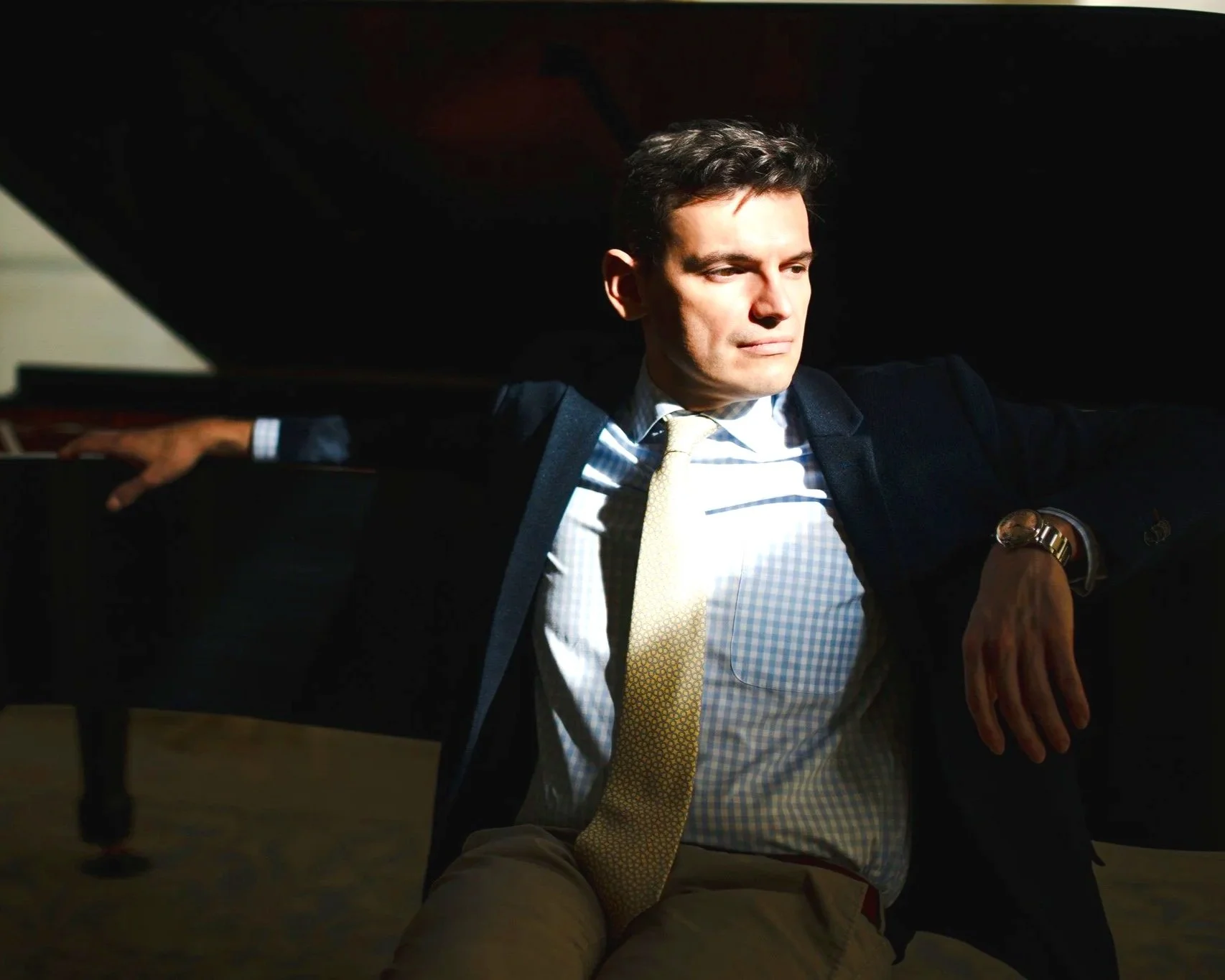
Adam Żukiewicz
Artist-in-Residence
Adam Piotr Żukiewicz is an award-winning, internationally acclaimed concert pianist. He concertized across Europe, United States, Canada, Japan, Brazil, Hong Kong, and Macau, and his performances were broadcast in the USA, Canada, Italy, Slovenia, Germany, and Poland. Mr. Żukiewicz consistently receives critical acclaim, while his innovative programming - focused on exploring connections between the popular and the lesser known gems of the traditional and contemporary repertoire - continues to engage and inspire audiences around the world. […]
Program Notes
Grażyna Bacewicz (1909–1969)
Piano Quintet No. 1 (1952)
Grażyna Bacewicz was among the most commanding musical voices of twentieth-century Poland: a composer of exacting craftsmanship, a formidable violinist, and an artist whose music joins structural discipline with extraordinary physical energy. Although her works have only recently begun to receive the international attention they deserve, Bacewicz was widely admired within Poland during her lifetime. Her immense catalogue encompasses symphonies, concertos, seven string quartets, sonatas, orchestral works, and a particularly rich body of music for strings. Her instincts for the instruments were not theoretical. She had enjoyed a distinguished performing career as a violinist and had served as concertmaster of the Polish Radio Orchestra before devoting herself more fully to composition.
Bacewicz completed her First Piano Quintet in 1952, at the height of a creative period in which her mature language had come into sharp focus. Her music is often associated with neoclassicism, though the term only partially describes what listeners encounter here. Formal clarity and contrapuntal control are certainly present, as are traces of Bartók, Stravinsky, and Prokofiev. Yet these elements are animated by something distinctly her own: an appetite for rhythm, a keen ear for instrumental color, and an expressive intensity that refuses to remain safely contained within its architecture.
The first movement opens in mystery. The strings emerge in a dark, searching unison while the piano answers with restrained chords, creating a sense of space before the music has fully declared its direction. From this inward beginning, the movement suddenly gathers momentum. The writing becomes taut and propulsive, driven by short motifs that pass rapidly through the ensemble. More lyrical ideas appear, but even these seem charged with suppressed motion. Bacewicz does not treat the piano and string quartet as opposing forces; instead, she continually recombines them, moving between orchestral weight, intimate dialogue, and lean passages in which a single instrumental line alters the atmosphere. The slow introduction eventually returns, leaving the movement suspended in the same enigmatic world from which it arose.
The Presto draws its energy from the oberek, a quick Polish dance in triple meter. Its rhythms whirl rather than march, often placing accents where the listener least expects them. Pizzicato strings, sudden changes of texture, and the piano’s bright athleticism give the movement a volatile brilliance. Beneath the exhilaration is exceptional control: Bacewicz creates the sensation of abandon without ever surrendering precision. A gentler central passage briefly interrupts the dance before the oberek returns with renewed momentum.
The Grave forms the emotional center of the quintet. Time seems to slow as the ensemble enters a sound world of tolling sonorities, isolated gestures, and long, searching lines. The music is deeply expressive without becoming confessional. Bacewicz allows grief and beauty to coexist in a language stripped of excess; the restraint of the writing makes its climaxes all the more powerful. Here, silence and resonance become nearly as consequential as melody.
The finale, marked Con passione, restores the music’s physical urgency. Compact motifs collide and combine, lyrical passages briefly open the texture, and contrapuntal lines accumulate with increasing force. Bacewicz repeatedly builds momentum, arrests it, and begins again, as though the music must gather its courage before each new surge. Near the close, the quintet recalls material from the opening movement, revealing a design that has been quietly binding the entire work together. The final Grandioso does not simply provide a triumphant conclusion; it transforms the work’s earlier uncertainty into a statement of hard-won conviction.
The Piano Quintet No. 1 is music of striking contrasts: lyrical and dissonant, disciplined and impassioned, rooted in Polish tradition yet unmistakably modern. Its power comes not from rejecting the past, but from subjecting inherited forms to a new degree of rhythmic pressure and emotional concentration. Bacewicz gives the piano quintet the weight of an orchestra and the immediacy of five individual voices, each caught within the same urgent current.
Antonín Dvořák (1841–1904)
Piano Quintet No. 2 in A Major, Op. 81, B. 155 (1887)
Antonín Dvořák’s Second Piano Quintet occupies a rare place in the chamber-music repertoire: it is both immediately inviting and endlessly rewarding. Its melodies possess the warmth and apparent naturalness of familiar songs, yet beneath them lies a work of remarkable structural imagination. Piano and strings move effortlessly between private conversation and almost symphonic grandeur, while moments of melancholy, tenderness, wit, and unrestrained celebration follow one another with the fluidity of remembered experience.
The designation “No. 2” carries a revealing history. Dvořák had composed an earlier piano quintet in A Major in 1872, while he was still defining his artistic identity. Fifteen years later, he returned to that youthful score with the intention of revising it. Rather than merely repairing the earlier work, however, he created an entirely new quintet in the same key. Written largely at his country residence in Vysoká between August and October 1887, Op. 81 reflects a composer at the height of his powers, confident in both his Czech musical inheritance and his command of the great European chamber tradition.
The first movement begins with disarming intimacy. Over a gently rocking piano accompaniment, the cello introduces a broad, lyrical melody. The opening is tender, almost pastoral, but the calm is soon interrupted by a forceful response from the full ensemble. This alternation between inward reflection and surging collective energy becomes essential to the movement’s character. A second principal theme, entrusted first to the viola, brings a different kind of lyricism: graceful, mobile, and tinged with longing.
Dvořák’s melodies often seem to have existed long before the music began, yet their apparent simplicity conceals sophisticated workmanship. Themes are passed between instruments, reshaped, fragmented, and placed in new harmonic light. The piano may provide a shimmering background in one moment and assume orchestral authority in the next. The four string players likewise alternate between singing as individuals and forming a single resonant body. By the movement’s jubilant coda, the quiet opening theme has traveled through a vast emotional landscape.
The second movement bears the title Dumka, a term associated with a Slavic tradition of reflective or elegiac song. For Dvořák, the dumka became less a fixed musical form than a way of thinking through contrasts: sorrow interrupted by animation, introspection answered by dance. The principal melody appears quietly in the piano in F-sharp Minor, spare and wistful, before being taken up and enriched by the strings.
This refrain returns several times, altered in color and emotional weight. Between its appearances, Dvořák introduces brighter, quicker episodes that seem at first to belong to another world. Yet melancholy and exuberance are not presented as opposites. Each changes the meaning of the other. The movement follows a broad rondo design, but it is experienced less as a formal pattern than as the recurring movement of memory, repeatedly drawn back to the same thought and finding it transformed upon every return.
The Scherzo is subtitled Furiant, after a spirited Czech dance. Traditional furiants frequently play with the listener’s perception of two-beat and three-beat rhythm; Dvořák evokes the dance’s vitality more through character than through strict imitation. The outer sections rush forward with buoyant accents, fleet passagework, and the irresistible sensation of musicians leaning into a communal dance. In the central trio, the activity recedes into something more dreamlike, as though the dance continues at a distance before returning in full color.
The finale begins with barely contained expectancy and soon bursts into motion. Its themes are agile, playful, and rhythmically alive, circulating rapidly among the five musicians. Dvořák’s contrapuntal skill becomes particularly apparent in the development, where the principal idea forms the basis of a fugato. The learned technique never feels academic; each entering voice adds to the gathering excitement.
Near the end, Dvořák performs one final act of transformation. The headlong movement pauses, and the principal theme appears in a broad, chorale-like form, hushed and momentarily removed from the dance. It is as though the music looks back upon its own happiness with gratitude. The pause is brief. The tempo accelerates once more, and the quintet races toward one of Dvořák’s most radiant conclusions.
Dvořák’s national identity is inseparable from this music, but its appeal does not depend upon recognizing a particular dance or cultural reference. He rarely quotes folk melodies directly. Instead, he creates original themes shaped by the inflections, rhythms, and communal spirit of Czech musical life, integrating them into forms inherited from the broader European tradition. The result is neither picturesque folklore nor abstract formalism, but a remarkably complete musical world.
The Piano Quintet in A Major speaks with generosity. Its sorrow is genuine, but never isolating; its joy is sophisticated, but never self-conscious. Dvořák invites the listener into music that feels at once carefully made and abundantly alive, where intimacy can become celebration and five instruments can seem to contain an entire landscape.
Program Notes by Reginald Winters