
Mini-Chamber 3
with Adam Żukiewicz - Piano
Saturday, March 20, 2027
7:30 – 9:00 PM
Boulder Adventist Church
Adam Żukiewicz - Piano
Artist-in-Residence
Program
Ludwig van Beethoven (1770–1827)
33 Variations on a Waltz by Anton Diabelli in C Major, Op. 120 (1823)
About the Artists
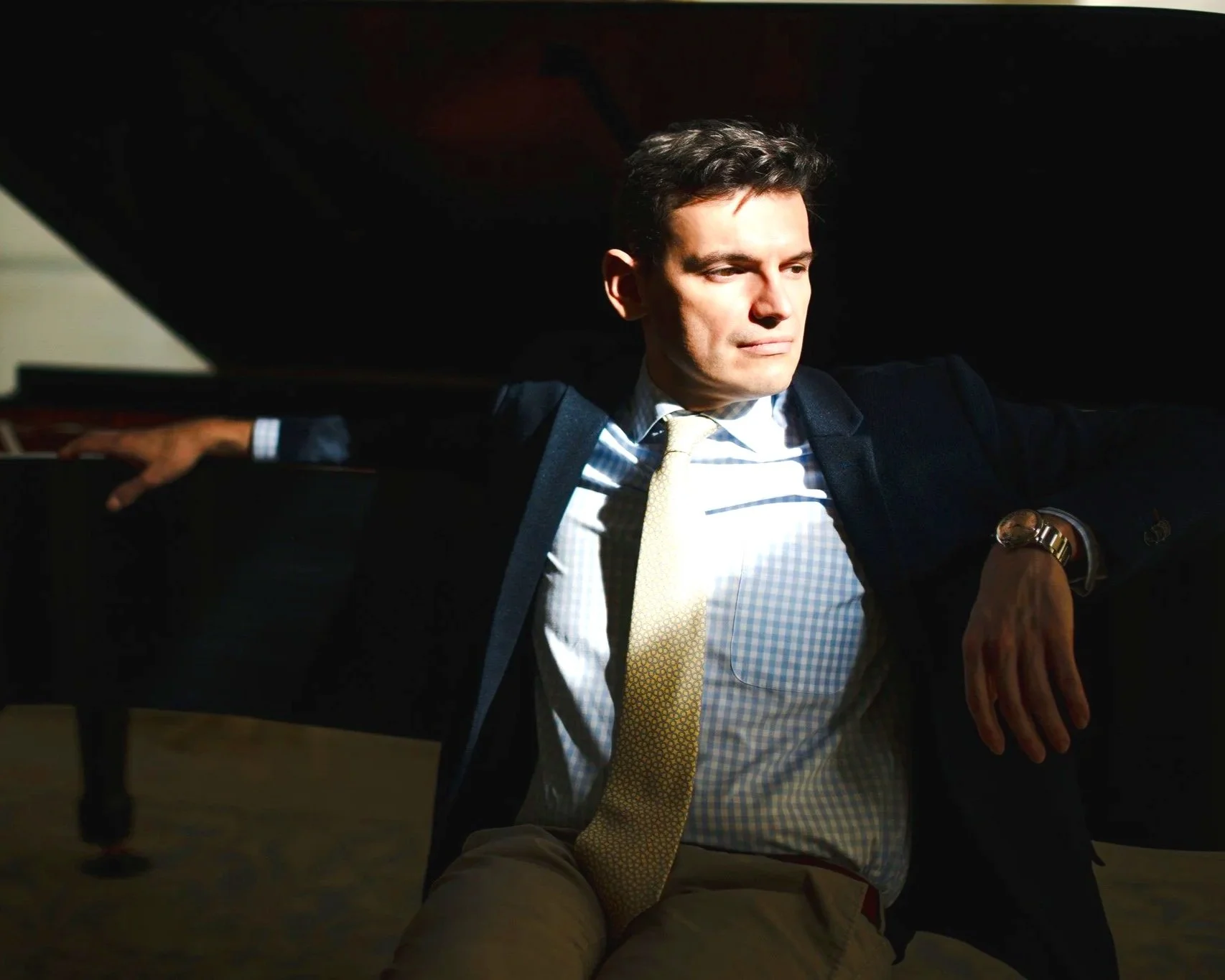
Adam Żukiewicz
Artist-in-Residence
Adam Piotr Żukiewicz is an award-winning, internationally acclaimed concert pianist. He concertized across Europe, United States, Canada, Japan, Brazil, Hong Kong, and Macau, and his performances were broadcast in the USA, Canada, Italy, Slovenia, Germany, and Poland. Mr. Żukiewicz consistently receives critical acclaim, while his innovative programming - focused on exploring connections between the popular and the lesser known gems of the traditional and contemporary repertoire - continues to engage and inspire audiences around the world. […]
Program Notes
Ludwig van Beethoven (1770–1827)
33 Variations on a Waltz by Anton Diabelli in C Major, Op. 120 (1823)
Beethoven’s Diabelli Variations begin with an object so ordinary that it scarcely appears capable of sustaining an hour of music. Anton Diabelli’s waltz is cheerful, sturdy, and insistently symmetrical. It offers a jaunty turn, repeated chords, predictable sequences, abrupt accents, and a bass line that seems almost determined to announce where it is going. The theme does not ask to be admired. It simply arrives, completes its appointed steps, and stops.
For Beethoven, this apparent simplicity became an invitation.
Diabelli, a composer and prominent Viennese music publisher, had circulated his waltz among a broad group of Austrian composers, asking each to contribute a single variation for a collective publication. Beethoven responded not with one variation, but with thirty-three. He began the work in 1819, set it aside while composing the Missa solemnis and his final three piano sonatas, and returned to complete it in 1823. Dedicated to Antonie Brentano, Op. 120 became his final large-scale work for solo piano and his most expansive exploration of variation form.
Yet “variation” may be too modest a word for what Beethoven undertakes. He does not merely decorate Diabelli’s melody or dress it in changing colors. At times, he abandons the tune almost completely, preserving only its harmonic foundation, rhythmic profile, repeated notes, opening turn, or descending interval. The waltz is examined from every conceivable angle: magnified, compressed, fragmented, contradicted, mocked, mourned, and finally transformed into something Diabelli could never have anticipated.
The first variation makes Beethoven’s intentions immediately clear. The modest waltz returns as a grandiose march, its domestic proportions inflated into something ceremonious and faintly absurd. Rather than easing the listener into a sequence of polite alterations, Beethoven begins by overturning the theme’s identity. The dance has been stopped in its tracks.
From there, the variations proceed through a succession of sharply drawn characters. Some are delicate and elusive; others are muscular, argumentative, or dazzlingly virtuosic. A whispered exchange may be followed by stamping octaves, an intimate song by an explosion of trills. Variation XIII reduces the music to emphatic chords separated by startling expanses of silence, as though the theme has been interrupted by its own punctuation. Variation XIV answers with a grave, monumental procession, only for the fleeting Variation XV to dissolve its solemnity almost at once.
The contrasts are theatrical, but they are never arbitrary. Beethoven listens beneath the waltz’s melody to discover the smaller materials from which it is made. An ornamental turn becomes an entire variation. A repeated note generates a new texture. A commonplace harmonic sequence is made mysterious through displacement or silence. The theme remains present even when it can no longer be recognized at first hearing.
Humor is central to this music. The familiar image of Beethoven as a solitary, scowling prophet tells only part of the story; the Diabelli Variations reveal a composer of audacious wit. Variation XXI lurches between frantic agitation and exaggerated complaint. Variation XXII quotes “Notte e giorno faticar,” Leporello’s opening aria from Mozart’s Don Giovanni, in which the servant grumbles about laboring night and day. Beethoven fits Mozart’s melody so naturally to Diabelli’s harmony that the quotation feels at once inevitable and delightfully impertinent. Variation XXIII resembles an overheated keyboard exercise, its mechanical virtuosity pushed close to caricature.
These jokes do not diminish the work’s seriousness. They enlarge it. Beethoven recognizes that the comic, awkward, tender, and sublime may belong to the same human world. The Diabelli Variations do not rise above the theme by pretending it was nobler than it is. Instead, Beethoven takes its limitations seriously enough to discover their imaginative possibilities.
At the center of the work stands Variation XX, an extraordinary Andante in which motion nearly ceases. Its quiet, sustained chords seem to suspend the passage of time. After so much activity, the effect is not merely restful; it is uncanny, like entering a room whose stillness changes one’s awareness of sound. From this “inner sanctum,” the music resumes its comedy and momentum, but the emotional scale of the work has deepened.
Variation XXIV introduces a poised, transparent fughetta, invoking an older contrapuntal tradition with affection rather than severity. Its refinement is immediately followed by the earthy humor of Variation XXV. This contrast begins the work’s final and most consequential span. The following variations increasingly loosen the waltz’s familiar outlines until the exuberance of Variation XXVIII reaches a breaking point.
Then the entire landscape changes.
Variations XXIX, XXX, and XXXI form an extended descent into C Minor. The first speaks in interrupted sighs; the second unfolds as a restrained lament; the third expands into an intensely ornamented Largo whose expressive language recalls the slow movement of Beethoven’s final piano sonata, Op. 111. Ornament here is not decoration but speech intensified beyond ordinary utterance. Trills and embellishments seem to circle thoughts too profound to be stated plainly. Together, these three variations create the emotional gravity of a great sonata’s slow movement.
The unresolved ending of Variation XXXI releases directly into the enormous fugue of Variation XXXII. Beethoven takes some of the waltz’s least distinguished materials—its repeated notes and simple intervals—and submits them to rigorous contrapuntal development. The music moves into E-flat Major, the only variation in which C is no longer the governing tonic, and gathers force until the fugue appears capable of concluding the entire work in triumph.
But Beethoven refuses the expected ending.
At the height of the fugue’s power, the music breaks apart. A series of quiet chords and sweeping arpeggios gradually removes its accumulated weight. Out of this astonishing transition emerges the final variation: not a more brilliant finale, but a graceful minuet.
The transformation is profound. Diabelli’s bustling waltz has become something spacious, poised, and inward. The final minuet acknowledges the world of Mozart and Haydn, but its serenity belongs unmistakably to late Beethoven. After the grotesque dances, silences, laments, and contrapuntal struggles that precede it, simplicity has acquired an entirely different meaning. The music has not returned to its beginning. It has discovered, within the ordinary, a kind of grace.
The final measures offer one last flash of wit before the work vanishes upward across the keyboard. Beethoven seems to close the vast journey with neither a monument nor a moral, but a knowing smile.
The achievement of the Diabelli Variations lies not in making a trivial waltz sound important. It lies in showing that no material is trivial to an imagination capable of listening deeply enough. From Diabelli’s modest theme, Beethoven creates a portrait of the piano, a history of musical styles, a comedy of human character, and one of his most searching meditations on transformation.
Program Notes by Reginald Winters