
Time Travel: Vienna, 1801
with Daniel Adam Maltz - Period Piano
Saturday, April 17, 2027
7:30 – 9:30 PM
Boulder Adventist Church
Bahman Saless
Music Director
with
Daniel Adam Maltz - Period Piano
Program
Ludwig van Beethoven (1770–1827)
Overture
Ludwig van Beethoven (1770–1827)
Piano Concerto No. 1 in C Major, Op. 15 (1801)
I. Allegro con brio
II. Largo
III. Rondo: Allegro scherzando
Daniel Adam Maltz - Period Piano
Ludwig van Beethoven (1770–1827)
Symphony No. 8 in F Major, Op. 93 (1812)
I. Allegro vivace e con brio
II. Allegretto scherzando
III. Tempo di menuetto
IV. Allegro vivace
About the Artists
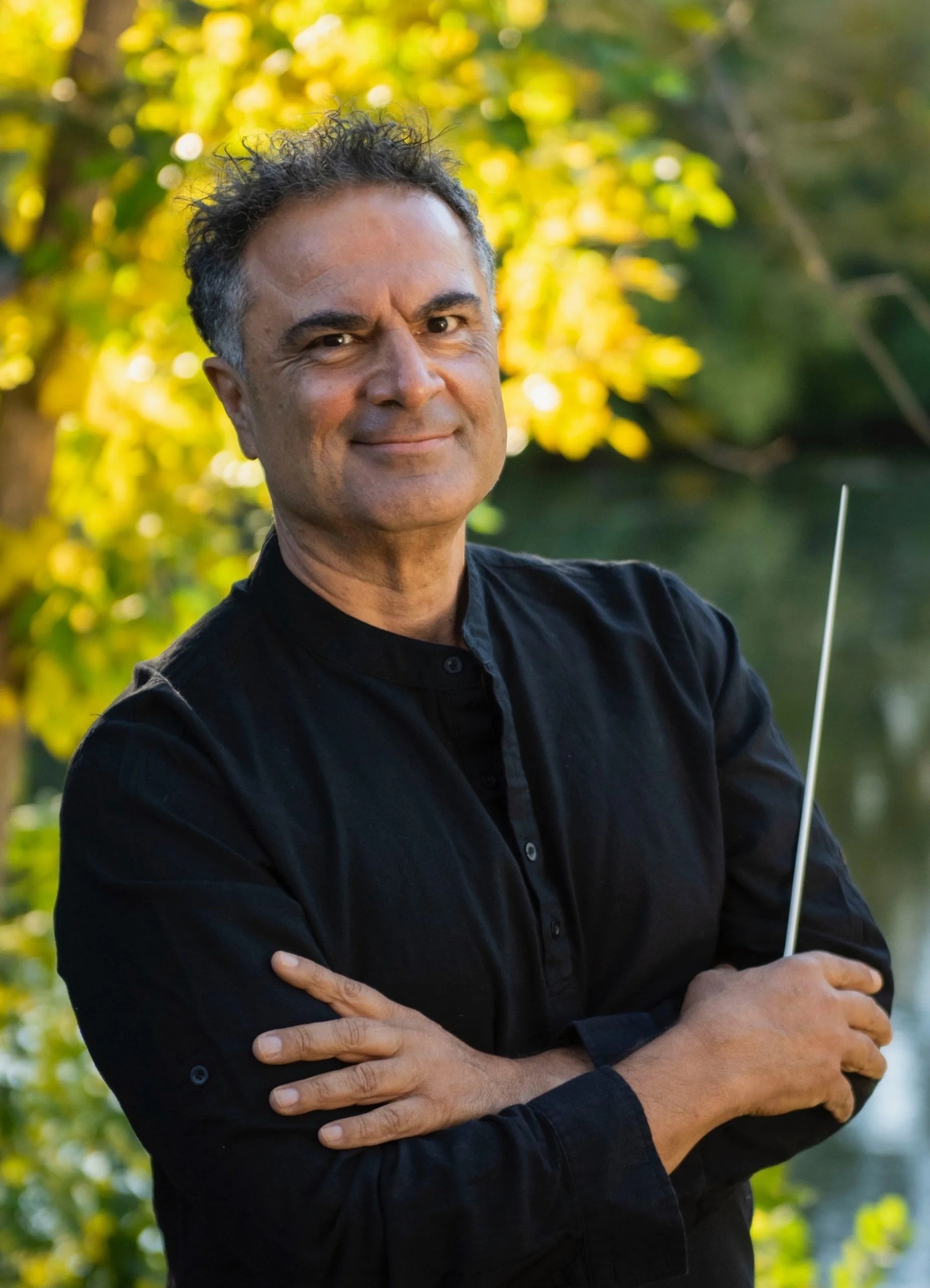
Bahman Saless
Music Director
A conductor for the 21st century, Bahman Saless has been described as “entrepreneurial, creative, and plugged in,” and “an innately talented musician and conductor, without frills or ego.” His passion is palpable, his enthusiasm contagious, and the results he draws from musicians are, as one colleague put it, “extraordinary.” Saless’s musical path is anything but conventional. After studying violin in England as a teenager and composing music from a young age, he pursued violin studies with Lyman Bodman at Michigan State University while […]

Daniel Adam Maltz
Period Piano
Daniel Adam Maltz is a fortepianist based in Vienna, Austria. He is the leading fortepianist of his generation, performing in 50+ cities per year as a sought-after soloist, director, and Lied accompanist. He is also an esteemed educator, visiting 60+ universities as a guest artist and clinician. Daniel specializes in Viennese Classicism — especially the works of Haydn, Mozart, and Beethoven — performed on the Viennese fortepianos of their time. He brings his expertise in the Viennese sound, culture, philosophies, and performance practices of the Classical era to his interpretations. […]
Program Notes
Ludwig van Beethoven (1770–1827)
Overture
Coming Soon.
Ludwig van Beethoven (1770–1827)
Piano Concerto No. 1 in C Major, Op. 15 (1801)
Beethoven’s First Piano Concerto introduces a young composer already determined to distinguish himself from the traditions he had inherited. Written largely during his first years in Vienna and revised before its publication in 1801, the concerto belongs to the period when Beethoven was establishing himself as one of the city’s most exciting pianists. Its proportions and elegance still reflect Mozart and Haydn, but its bold contrasts, muscular rhythms, and theatrical sense of timing announce a markedly different personality.
The designation “No. 1” refers to the order of publication rather than composition. Beethoven’s Piano Concerto No. 2 was begun earlier, though it was revised and published later. By placing the C Major Concerto first, Beethoven offered the public a work that projected confidence, brilliance, and ambition on a grand scale.
The opening movement begins with the orchestra alone. A quiet, almost understated theme is answered by increasingly assertive gestures, and the music gradually expands into a substantial orchestral exposition. When the piano finally enters, it does not simply repeat what has already been heard. The soloist introduces new ideas, ornaments familiar themes, and immediately begins testing the boundaries of the orchestral argument. Throughout the movement, piano and orchestra alternate between cooperation and competition. Sudden changes in dynamics, unexpected harmonic turns, and emphatic accents reveal Beethoven’s delight in unsettling convention without abandoning it.
The Largo moves to the distant key of A-flat Major, creating an immediate change of color. Muted strings and softly blended winds surround the piano with unusual warmth, while the soloist unfolds long, spacious lines of an almost vocal character. The clarinet assumes a particularly prominent role, often answering or accompanying the piano as an intimate second voice. Beneath the movement’s serenity lies a sophisticated dialogue of color and harmony, but Beethoven allows the music to speak with remarkable directness.
The finale reveals his humor at its most engaging. Its principal theme is playful, angular, and rhythmically unpredictable, full of accents that seem to land just beyond expectation. The piano darts through brilliant passagework while the orchestra responds with equal wit. Contrasting episodes introduce rustic energy and flashes of lyrical charm, yet the movement’s buoyancy never disappears for long.
Near the end, Beethoven briefly interrupts the momentum before sending the concerto toward a conclusion of sparkling assurance. The effect is characteristic: even when the destination is clear, the route remains delightfully unpredictable. The concerto belongs to Beethoven’s youth, but its essential qualities are already present. Music becomes argument, surprise becomes structure, and virtuosity becomes a form of dramatic character.
Ludwig van Beethoven (1770–1827)
Symphony No. 8 in F Major, Op. 93 (1812)
Beethoven completed his Seventh and Eighth Symphonies within a remarkably concentrated period, yet the two works could hardly possess more different public identities. The Seventh has long been celebrated for its rhythmic grandeur and overwhelming momentum. The Eighth, shorter and more compact, has sometimes been treated as its lighter companion. Such a description captures the symphony’s wit, but not its audacity. Beneath its Classical proportions lies some of Beethoven’s most concentrated, unpredictable, and brilliantly disruptive writing.
The first movement begins without introduction or preparation. The full orchestra launches immediately into a theme of exuberant confidence, as though the music has already gathered momentum before the first note is heard. Yet the movement’s apparent good humor is continually complicated by violent accents, abrupt changes of dynamics, and phrases that push beyond their expected limits. Beethoven takes gestures associated with Haydn’s symphonic world and magnifies their capacity for surprise. Even the movement’s climax becomes a feat of deliberate excess, with the principal theme proclaimed at extraordinary force above a thundering bass line.
The second movement is not the slow movement listeners might expect. Instead, Beethoven offers a compact Allegretto built upon steady, detached chords in the woodwinds. The movement has often been associated with the mechanical ticking of a metronome, although the familiar story linking it directly to the inventor Johann Nepomuk Mälzel is doubtful. What remains unmistakable is the music’s fascination with mechanical regularity. Against the woodwinds’ persistent pulse, the strings introduce a light, conversational melody that becomes increasingly animated. Order gradually gives way to comic impatience, as though the mechanism itself has begun to misbehave.
Rather than writing a scherzo, Beethoven turns backward in the third movement to the older minuet. This is no delicate courtly dance. Heavy accents and broad gestures give it a deliberately robust character, while the central trio offers one of the symphony’s most distinctive sonorities. Two horns and clarinet sing above flowing cello accompaniment, creating a moment of pastoral warmth amid the surrounding humor.
The finale begins almost too quietly to notice. A rapid string figure slips into motion, repeatedly interrupted by a loud, apparently unrelated note. What initially seems like a comic disturbance eventually becomes structurally important, influencing the movement’s harmonic direction and returning at crucial moments.
From this small disruption, Beethoven constructs an enormous finale. Themes race forward, disappear, and return in unexpected keys. The music repeatedly appears ready to conclude, only to discover another path. Its coda expands to extraordinary proportions, turning the act of ending into the movement’s final joke. Beethoven insists upon the closing chord so many times that certainty itself becomes comic.
The Eighth Symphony looks backward toward Classical forms while treating them with unmistakably modern self-awareness. Its humor depends upon a sophisticated understanding of expectation: where a phrase should end, when a cadence should arrive, and how long a conclusion ought to last. Beethoven does not reject tradition. He knows it so intimately that he can bend it, interrupt it, and invite the listener to share in the joke.
Program Notes by Reginald Winters