
Time Travel: Vienna, 1802
with Daniel Adam Maltz - Period Piano
Sunday, April 18, 2027
7:30 – 9:00 PM
Boulder Adventist Church
Daniel Adam Maltz - Period Piano
Program
Ludwig van Beethoven (1770–1827)
7 Bagatelles, Op. 33 (1802)
I. Andante grazioso, quasi allegretto
II. Scherzo: Allegro
III. Allegretto
IV. Andante
V. Allegro ma non troppo
VI. Allegretto quasi andante
VII. Presto
Ludwig van Beethoven (1770–1827)
Piano Sonata No. 14 in C-sharp Minor, Op. 27, No. 2, “Moonlight” (1801)
I. Adagio sostenuto
II. Allegretto
III. Presto agitato
Ludwig van Beethoven (1770–1827)
Piano Sonata No. 3 in C Major, Op. 2, No. 3 (1795)
I. Allegro con brio
II. Adagio
III. Scherzo: Allegro
IV. Allegro assai
Ludwig van Beethoven (1770–1827)
Andante favori in F Major, WoO 57 (1803–04)
Ludwig van Beethoven (1770–1827)
Rondo in C Major, WoO 48 (1783)
About the Artists
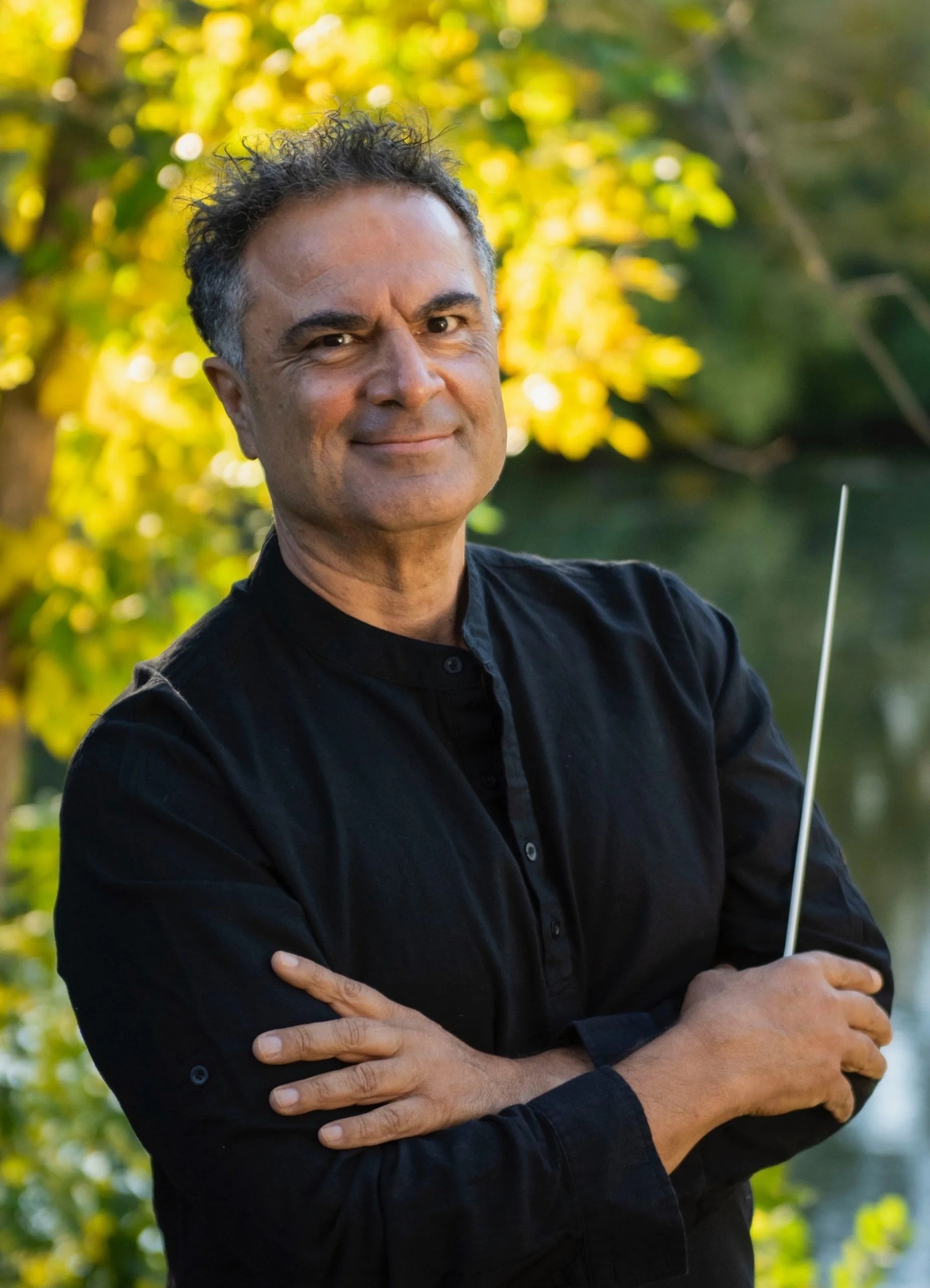
Bahman Saless
Music Director
A conductor for the 21st century, Bahman Saless has been described as “entrepreneurial, creative, and plugged in,” and “an innately talented musician and conductor, without frills or ego.” His passion is palpable, his enthusiasm contagious, and the results he draws from musicians are, as one colleague put it, “extraordinary.” Saless’s musical path is anything but conventional. After studying violin in England as a teenager and composing music from a young age, he pursued violin studies with Lyman Bodman at Michigan State University while […]

Daniel Adam Maltz
Period Piano
Daniel Adam Maltz is a fortepianist based in Vienna, Austria. He is the leading fortepianist of his generation, performing in 50+ cities per year as a sought-after soloist, director, and Lied accompanist. He is also an esteemed educator, visiting 60+ universities as a guest artist and clinician. Daniel specializes in Viennese Classicism — especially the works of Haydn, Mozart, and Beethoven — performed on the Viennese fortepianos of their time. He brings his expertise in the Viennese sound, culture, philosophies, and performance practices of the Classical era to his interpretations. […]
Program Notes
Ludwig van Beethoven (1770–1827)
7 Bagatelles, Op. 33 (1802)
The word bagatelle suggests something slight: a trifle, a passing amusement, an idea too small to require the architecture of a sonata. Beethoven repeatedly challenged that assumption. His bagatelles are often brief, but they are rarely inconsequential. Within a few pages, he can establish a character, overturn it, and disappear before the listener has fully understood what has happened.
The sketches for Op. 33 date principally from 1801 and 1802, and Beethoven completed the autograph in 1802 before the collection appeared in print the following year. The seven pieces do not form a continuous narrative, yet their contrasts create the pleasures of a carefully arranged gallery.
The opening bagatelle is poised and conversational, its graceful surface enlivened by small hesitations and changes of direction. The second is a compact scherzo, full of abrupt accents and quick exchanges between registers. The third and fourth turn toward a more lyrical world, while the fifth introduces a sturdier humor, transforming a simple rhythmic idea through unexpected pauses and emphatic responses.
In the sixth bagatelle, Beethoven requests una certa espressione parlante: a certain speaking expression. The phrase captures something essential about the entire collection. These pieces do not merely present melodies; they gesture, question, interrupt, and reply. The final Presto compresses that conversational energy into a brilliant conclusion, racing forward with an exuberance out of proportion to its modest dimensions.
The Bagatelles of Op. 33 reveal Beethoven not as the builder of monuments, but as a master of concentrated observation. A rhythmic displacement, a misplaced accent, or a sudden silence is enough to reveal an entire personality.
Ludwig van Beethoven (1770–1827)
Piano Sonata No. 14 in C-sharp Minor, Op. 27, No. 2, “Moonlight” (1801)
Beethoven did not call this work the “Moonlight” Sonata. His title was Sonata quasi una fantasia, suggesting a sonata conceived “in the manner of a fantasy.” The familiar nickname arose from a description published by the poet and critic Ludwig Rellstab in 1823, who associated the first movement with moonlight over a lake. The sonata was dedicated to Countess Giulietta Guicciardi, one of Beethoven’s piano students.
The poetic nickname has become inseparable from the work, but it can also obscure Beethoven’s more radical achievement. Rather than beginning with a vigorous sonata-form movement, he opens with an Adagio of extraordinary stillness. A continuous triplet figure moves beneath a restrained melody, creating the impression of thought unfolding within an atmosphere that never entirely clears. Beethoven instructed that the movement be played with the greatest delicacy and without dampers, allowing its harmonies to blend within the resonance of the piano.
The Allegretto offers temporary relief. Its light, graceful phrases stand between the surrounding movements like a brief conversation in another room. Franz Liszt famously described it as “a flower between two abysses,” an image that captures both its charm and its precarious position.
The final Presto agitato releases the energy that the opening movement has held in suspension. Rapid arpeggios surge across the keyboard, accents strike against the prevailing motion, and lyrical ideas are drawn almost immediately back into the turbulence. The movement demands virtuosity, but its difficulty is inseparable from its emotional character. The pianist is not decorating the music; the pianist is attempting to contain it.
The sonata’s true drama lies in its distribution of weight. It begins in restraint and ends in extremity, reversing the customary expectation that the opening movement will carry the greatest force. Heard as a complete work, the “Moonlight” Sonata is not simply a portrait of nocturnal melancholy. It is a passage from inward stillness to an agitation that can no longer remain unspoken.
Ludwig van Beethoven (1770–1827)
Piano Sonata No. 3 in C Major, Op. 2, No. 3 (1795)
Beethoven’s three sonatas of Op. 2 were the first piano sonatas to which he assigned an opus number, signaling the importance he attached to them. Published as a set and dedicated to Joseph Haydn, they introduced the Viennese public to a pianist-composer prepared to work within the Classical tradition while testing nearly every boundary it offered.
The Third Sonata is the most expansive and outwardly brilliant of the collection. The opening movement begins with an idea that seems almost deliberately modest: a clipped rhythmic figure followed by a quick ascending gesture. Beethoven rapidly enlarges it into music of near-concerto proportions. Brilliant passagework, orchestral contrasts, and a written-out cadenza near the conclusion allow the pianist to assume the role of virtuoso protagonist.
The Adagio moves unexpectedly to E Major, a distant key whose warmth immediately changes the instrument’s color. Its opening is spacious and noble, but darker episodes disturb the calm with sudden accents and dramatic silences. Even in a movement of apparent repose, Beethoven allows serenity to coexist with unease.
The Scherzo begins quietly, with a theme that seems to test its footing before gathering confidence. Its central trio descends into flowing minor-key lines, after which the opening material returns with renewed wit. Beethoven replaces the traditional minuet with something quicker, more pointed, and less socially predictable.
The finale is propelled by rapid motion and a sense of theatrical delight. The opening scurries across the keyboard, while contrasting themes introduce lyricism without slowing the momentum for long. Near the conclusion, the brilliance recedes unexpectedly, and the sonata ends not with overwhelming force but with elegance and precision.
This is youthful Beethoven at his most assured. The inherited forms remain recognizable, but they have already become stages upon which timing, surprise, and physical energy can assume dramatic lives of their own.
Ludwig van Beethoven (1770–1827)
Andante favori in F Major, WoO 57 (1803–04)
The Andante favori was originally conceived as the slow movement of Beethoven’s “Waldstein” Sonata, Op. 53. He ultimately decided that its generous proportions disrupted the sonata’s balance and replaced it with the brief, mysterious introduction now heard before the “Waldstein” finale. The discarded movement was published independently and became sufficiently popular that, according to Carl Czerny, Beethoven himself referred to it as a “favorite Andante.”
The work begins with a melody of disarming simplicity. Gentle, symmetrical phrases unfold over a lightly moving accompaniment, returning throughout the piece with increasingly elaborate ornamentation. Between these appearances, the music moves into more distant and dramatic territory. Delicate embellishments give way to brilliant runs, emphatic chords, and sonorities that suggest the breadth of an orchestra.
Yet the principal melody continually restores a sense of intimacy. Each return feels familiar, but never identical; what initially appeared innocent gradually acquires memory and emotional weight. Freed from its intended place within the “Waldstein” Sonata, the Andante favori stands as a complete meditation on return, transformation, and the expressive possibilities contained within an apparently simple song.
Ludwig van Beethoven (1770–1827)
Rondo in C Major, WoO 48 (1783)
Published in 1783, the Rondo in C Major belongs among Beethoven’s earliest surviving works for piano. It appeared while he was still a young musician in Bonn, years before his move to Vienna and the works through which he would redefine the sonata, concerto, and symphony.
Its principal melody is clear, cheerful, and balanced, returning between short contrasting episodes in the customary manner of a rondo. The writing reflects the graceful keyboard style of the late eighteenth century, yet small surprises already suggest a composer attentive to contrast and timing. The music moves between registers with increasing freedom, briefly darkens its harmony, and reserves fresh activity for the closing measures.
This youthful Rondo does not yet speak in the unmistakable language of the mature Beethoven. Its fascination lies instead in hearing a gifted young composer learning how musical ideas leave home, encounter contrast, and return with their identities newly sharpened.
Program Notes by Reginald Winters